Snow Physical properties and Assessment of Radiative transfer in the snowpacK
Optical properties are central to snow science. The intensity and spectral distribution of the radiation that reaches the lower layers of the snowpack is governed by scattering and absorption, which in turn depend on crystal size distribution and shape, stratification, and the presence of light-absorbing impurities within the snowpack. Therefore, optical probes are an ideal tool to exploit this relationship and gain insights on the ever-evolving morphology and content of the snowpack. Most of the incident radiation is either reflected or absorbed near the surface allowing, for example, the detection of spectral signatures by satellite-based remote sensing to infer snow cover, water equivalent content, and other related physical properties. However, a non-negligible fraction penetrates deeper layers and the specific trend at which it does so can provide insights on the cryosphere. The lack of high-resolution measurements within the uppermost centimeters of the snowpack represents a persistent gap that limits progress in further resolving the coupled physical, biological, and chemical processes that occur in this critical layer. SPARK will characterize the light propagation through the snowpack by exploiting a pure experimental and innovative approach based upon a novel custom-made probe will be specifically designed, realized, and characterized by the Instrumental Optics group at the Physics Department in Milan. By simply driving the probe into the snow by a stick, quantitative data for several optical parameters will be automatically acquired with high vertical resolution. The technology stems from the experience accumulated in the last years developing two preliminary devices, already tested in the real environment by our research group [4, 5]. The functionalities of these two probes will be integrated in the novel one, optimized for providing simultaneous measurements of sunlight propagation, stratigraphy and the characteristic size of ice crystals. This innovative observational method will considerably expand the information currently available from snow spectral measurements and snow pit analysis, with the strong advantages of minimizing the invasiveness of sampling and allowing for a large number of sampling sites in short times.
Objectives
SPARK is articulated around three main objectives:
- Design and realization of the novel portable probe optimized for field measurements in cold environments, leveraging the architecture and operating principle of the two probes already validated by the Instrumental Optics laboratory. This could offer the research community a cost-effective and user-friendly instrument that is not currently available.
- Field testing, calibration and validation on the Italian Alps and Svalbard in diverse snowpacks, taking advantage of the uniquely diverse conditions these areas are exposed to.
- Study the relationship between radiative transfer in snow, the snowpack stratigraphy, and the morphological properties of snow crystals, by conducting measurements in the polar snowpack and integrating meteorological data from local research stations. A systematic analysis based on radiative transfer models such as the “SNow, Ice and Aerosol Radiative” (SNICAR) model will also be performed to this end.
In pursuing these objectives, the project will endeavor to answer the following open questions:
- How do snow metamorphism processes impact the penetration depth of light in the snowpack and the time scales of its evolution.
- How do light propagation, layer density and compactness, and ice crystals size correlate to each other.
- Are there exploitable proxies for critical fragile layers or weakening metamorphisms that can provide early warnings for instability or avalanches.
The probe will measure the following physical observables, as sketched in Figure 1:
- The sunlight flux propagating in the uppermost layers of the snowpack in three different spectral bands with high spatial resolution (less than 2 mm).
- The occurring internal stratification of the snowpack and the average characteristic grain size in each snow layer, with the same high spatial resolution. This method takes advantage of the highly diffusive nature of snow (caused by many ice-air interfaces, grain randomness, and surface roughness) which makes light scatter repeatedly. When monochromatic light passes through snow, it produces a speckle field that precisely varies with the snow’s grain structure. By computationally analyzing time-resolved backscattered light intensity at different depths using statistical tools, one can derive an optical stratigraphy that reveals the fine structure and distribution of snow grains.
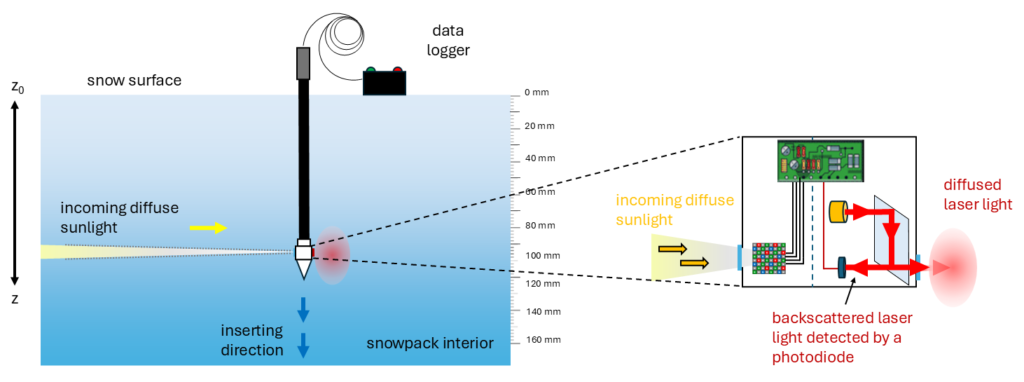
Figure 1: Schematic of the measurement procedure with the probe. The probe is inserted vertically with respect to the snow surface (z0) down to depth z in the snowpack in steps of 10 mm. Signal digitization is performed within the probe, data are stored into the external data logger. An inset of the internal organization of the novel probe is also provided on the right.
Referents:
- prof. Marco A. C. Potenza, marco.potenza@unimi.it
- dott. Luca Teruzzi, luca.teruzzi@unimi.it
- Valentina Raspagni, valentina.raspagni@unive.it
- Elena Vignati, elena.vignati@unive.it